Overview
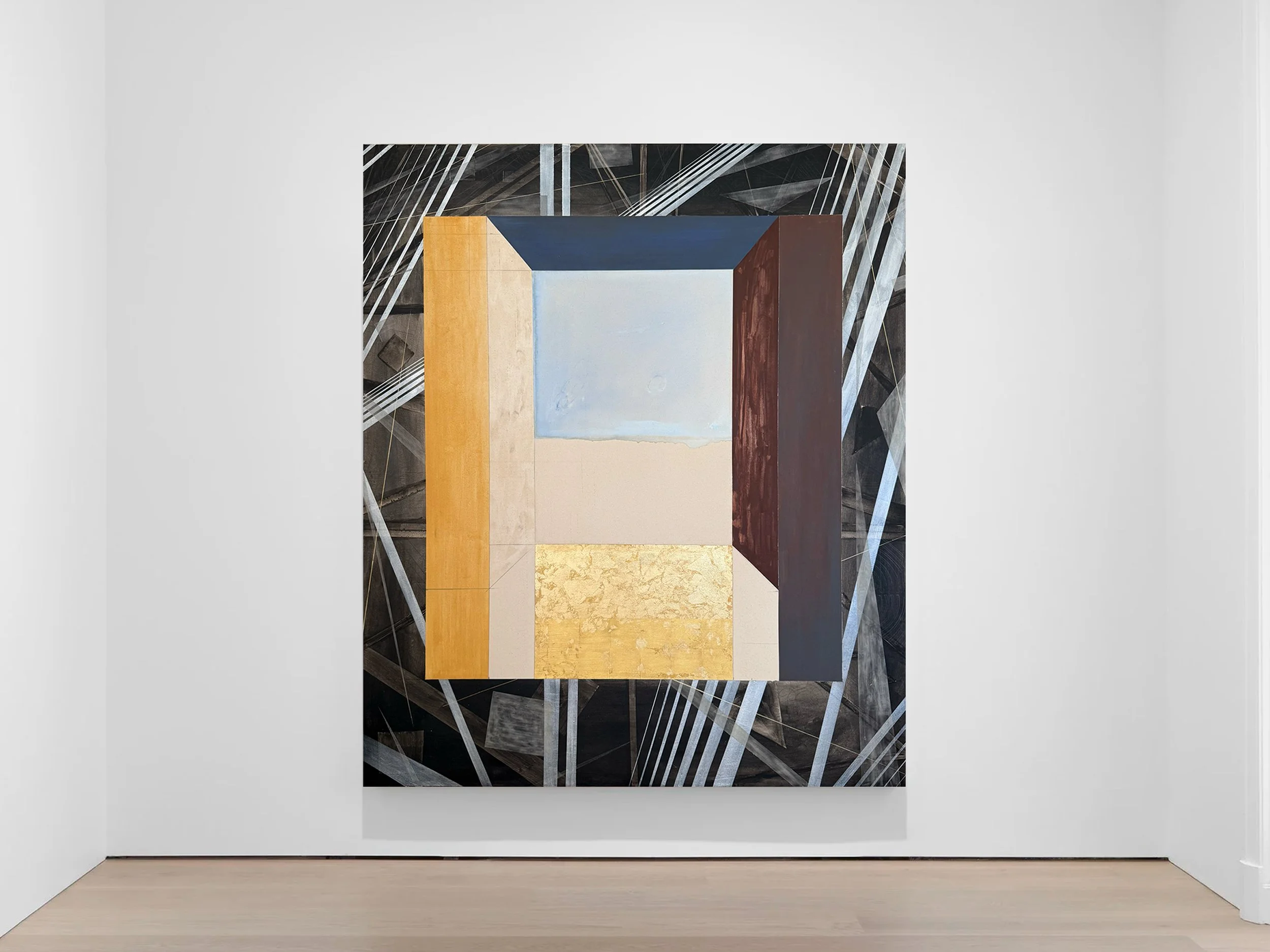
Amadour’s Nevada Proscenium (2026– ) is an ongoing painting series and exhibition project that positions Nevada as an active stage shaped through visibility, labor, extraction, and memory. Rooted in geometric abstraction, the series rejects the myth of the American West as an empty frontier, instead approaching the desert as a site saturated with layered cultural histories, ecological consequence, and lived experience. Drawing from Nevada’s mining infrastructures, open horizons, and architectures of division, the paintings transform the landscape into a spatial field where identity, migration, labor, and power remain embedded within form itself.
Constructed through gold and silver leaf, graphite, acrylic, and layered surfaces on canvas, the works employ modular geometric structures influenced by mine-shaft timbering systems developed during the Comstock era in Virginia City. Rectangular forms operate simultaneously as architectural frameworks, thresholds, and metaphors for containment, surveillance, passage, and cultural memory. Rather than depicting landscape directly, the series examines how Nevada has been structured, extracted, and mythologized through systems of visibility and erasure. Silver leaf surfaces are intentionally allowed to oxidize over time, introducing instability and transformation into the paintings while echoing Nevada’s shifting histories of valuation tied to silver and gold extraction.
Art Historical Context
Art historically, Nevada Proscenium draws from geometric abstraction, postwar minimalism, Light and Space practices, and conceptual systems-based art. The project positions geometry not as pure formalism but as a structure through which histories of labor, migration, and landscape can be perceived. Influences include the spatial atmospheres and cultural framing devices of Colombian painter Ana Mercedes Hoyos’s Ventana series, as well as the imagined psychological landscapes of Helen Lundeberg, whose work constructed place through projection, distance, and interiority.
The serial logic of the paintings is additionally informed by Sol LeWitt and Channa Horwitz, particularly through repetition, modularity, and systems of ordered variation. At the same time, the project engages the material restraint and chromatic subtlety associated with postwar abstraction and Light and Space practices in California. Open spatial fields throughout the series function both formally and symbolically: as apertures of reflection, fragmentation, freedom, and self-determination. Within this framework, Nevada Proscenium positions abstraction as a space where personal biography, collective memory, and the environmental realities of the American West converge.
Selected Lineages and References
Points of reference for Nevada Proscenium include Ana Mercedes Hoyos’s Ventanas series (1974–1981), particularly works such as Ventana (1974) and Ventana Roja (1979), for their engagement with framing, cultural memory, and interior-exterior spatial relationships. The project also draws from Helen Lundeberg’s geometric and architectonic abstractions, including Aegean Light (1973) and Planet (1965), where flattened perspective, spatial compression, and atmospheric geometry transform landscape into psychological structure. Early geometric paintings by Mary Corse, including Untitled (White Inner Band) (1966) and Untitled (Black Earth Series) (1978), further inform the work by their treatment of light as both a material and a perceptual event, activating the surface through subtle spatial shifts and restrained formal systems.
The serial and structural logic of the paintings further resonates with Sol LeWitt’s modular cubic works, including Incomplete Open Cubes (1974) and Variations of Incomplete Open Cubes (1974), alongside the notation-based systems of Channa Horwitz’s Sonakinatography drawings (begun 1968), which translated rhythm, duration, movement, and musical notation into visual structures governed by systematic logic. Richard Anuszkiewicz’s Temple of Yellow (1967) and Temple of Orange Light (1971) additionally inform the work through their perceptual geometry, chromatic vibration, and architectonic spatial illusionism.